
Get started fast
You could be selling by tomorrow.
Switch to Shopify
Get more customers. Make more sales.
Trusted by enterprise brands
No matter your size, complexity, or ambition.
Built into every store
World's best checkout
Proven to convert better.
Sidekick
Your commerce-obsessed AI assistant.
Build your website
Sell anywhere
Marketing & analytics
Run your business
Get paid
Commerce for Agents
Build with our agent tools
Shopify App Store
Largest commerce ecosystem
Shopify.dev
Dev docs, CLI, and more
Non-stop innovation
Shopify Editions
150+ updates to Shopify, twice a year.
Latest updates
Unify online and in-person sales today
Explore the Point of Sale system with everything you need to sell in person, backed by everything you need to sell online.
Learn how social proof and retail cues shape buyer decisions. Add reviews, crowds, and trust signals to lift conversions—start optimizing today.
Unify online and in-person sales today.
For free.
Ever walked into a place, liked what you saw, and still wondered, “Did I make a mistake?” That split-second doubt is exactly where social proof and retail collide—and it can quietly make or break sales.
There’s not much more I love in this world than a great taco. And I love looking for and trying new, authentic Mexican and Latin restaurants.
But recently something happened to disrupt my experience of a restaurant I hadn’t been to before — despite my eagerness to try new places and consume more tacos.
I enjoyed my food. I liked the atmosphere. But the entire time, I was wondering if I made a bad choice in selecting this restaurant. I was paranoid that I was missing something — or that other diners knew something I didn’t.
Why? Because it was 6 p.m. on a Friday night in downtown Boston and hardly anyone was in this restaurant.
This was downright weird. Most places are packed, and I expected an after-work crowd at the bar at the very least. The restaurant was massive but only a handful of diners occupied tables.
This is the power of something called social proof. Had the restaurant been packed full of patrons, I likely would have felt like the food was even better than it really was and had an inflated opinion of the restaurant.
Despite the fact that I liked my food, the restaurant, and the overall experience, I was anxious the entire time because there was no social proof to make me feel better about my choice in dining there.
Humans look to others in their social groups to help inform their choices. That’s social proof. We want to make the right choice, so we look at what “society” at large does to figure out the correct action in a given situation.
Society can mean a small group in our immediate vicinity. It can be our peer groups, friends, and family. It can be our communities or it can be society on larger scales.
In any situation, we tend to look at what others are doing because it gives us confidence that we’re making the best decision when we need to choose what to do.
Social proof is more of a marketing term than a scientific one. But the idea is based in real science.
Psychologists would call social proof something like conformity bias or herd mentality. Some crowd-behavior research suggests a small minority (around 5% in certain large-crowd movement experiments) can influence group direction in the context of crowd movement (for example, when large groups are navigating and people are deciding which way to go). See Psych Central’s overview of herd mentality and crowd movement. When it comes to consumers making decisions, people may also follow others because they’re looking for more information to help them make choices (often called informational social influence), as summarized by Simply Psychology’s conformity explainer.
That’s why, if I looked around and found lots of other happy diners in that restaurant, I would have felt more confident about my decision to eat there. Instead, with no one there — even if there was a perfectly good reason for the lack of other customers — my instinct was to feel immediately uneasy and uncertain about whether I took the correct action in choosing the restaurant.
But this is just one type of social proof. I felt influenced by the “wisdom of the crowds,” and wanted to find approval (in the form of others acting as I did) from a large group. Other types of social proof could include:
As a retailer, you can use this phenomenon and all types of social proof to your advantage. By displaying social proof in a variety of ways, you can impact how customers think about your products and your brand to boost sales.
Start with these five strategies to put your social proof on display and influence customers to make more purchases.
Given choices, people tend to drift toward the option that attracts other people. We assume there must be something good and worthwhile there, and we trust the crowd to know something we don’t.
Just like the story about the empty restaurant, potential customers can pass your store by if it’s consistently empty. There’s no immediate, visual social proof that your store is where they need to be.
Increasing foot traffic to your stores creates that social proof for other shoppers walking by who need to make a choice about what location to visit next.
To get started, try setting signage outside to lead people into your store. You can promote specials or sales to entice customers to browse shelves. Or you could get a little creative and find ways to make an impression. Using humor is one way to make your store more memorable to those walking by. Being funny may encourage shoppers who appreciate a good sense of humor to stop in and see what your shop has to offer.
Offering samples is another great way to increase foot traffic and generate social proof by getting a larger crowd in your location. Teavana was masterful at this (when its mall stores were open), offering samples that anyone could grab at the door — but providing even more for customers who ventured inside. (Teavana’s retail stores were later folded into Starbucks’ operations; see Teavana’s history.) Teavana also did a nice job of keeping associates both on the floor and near the doors to quickly answer new customer questions or to make suggestions based on the samples people enjoyed.
You don’t have to give product away for free to encourage customers to walk through your doors. You can allow people to “sample” what you offer through excellent window displays, too. This gives them a preview of what they can find in the rest of your store.
If you can find creative ways to display items and products, you can create a sense of excitement or even curiosity: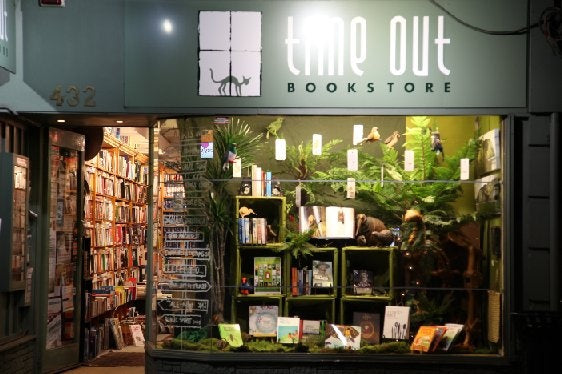 Jenna Todd of Time Out Bookstore didn’t just prop books up in the windows. She created a visually appealing display that invites readers to enter a lush world of books to discover new stories — and the glass door allows potential shoppers to get a peek at the shelves bursting with books inside.
You can influence customers to feel like buying from you is the correct action by displaying testimonials from previous shoppers. In stores, you can do this with signage and displays.
You don’t need to list out long quotations — even a photo with a one-sentence comment from a customer sharing something positive, useful, and compelling about a product you sell. You can lean on social media to source quotes, comments, and photos from real customers to then display in-store.
And of course, you can use social networks themselves as a way to promote and share testimonials. Living Proof is a beauty brand that does a great job of cultivating social proof from social media, featuring users of its products, their photos, and their comments.
While you can collect testimonials organically and display unsolicited comments from customers, you can also turn to influencer marketing to help create social proof for your business.
American Eagle’s #AerieREAL campaign for one of its clothing lines featured women who weren’t professional models. None of the photos were retouched or altered, and the brand showcased a number of body shapes and sizes.
Many of the women they selected had huge followings on social media platforms like Instagram, who helped American Eagle promote the campaign with photos, testimonials, and empowering stories.
This boosted Aerie’s social proof, as potential customers saw written testimonials and real-life photos of a wide range of different women wearing the pieces they sold.
Want to include testimonials on your website? HubSpot’s marketing blog put together a collection of testimonial page examples from a variety of companies and retailers that you can use for inspiration.
There’s also a collection of Shopify apps that allow you to seamlessly add social proof to your ecommerce site. Try Fomo to add notifications of recent purchases to your site, or Loox to add customer reviews and photos.
This is one of the easiest ways to use social proof to increase product sales, especially of specific items. If one of your products gets rave reviews, show those on your website on its page.
Allow customers to rank their favorite purchases and leave comments about what they bought. This can encourage other customers to buy based on the positive feedback of others, since new customers will feel more confident that they too will enjoy the product.
REI provides a detailed snapshot of customer reviews and ratings on their products, summarizing how people rated items, allowing shoppers to read comments from previous buyers, and ranking those comments by how helpful they are: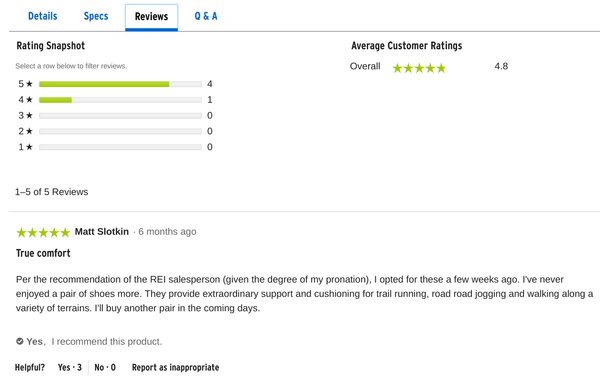 Try Judge.me or Storesmiths Products Reviews to add specific product reviews to your Shopify ecommerce site.
Remember, social proof is the phenomenon that has people look to larger groups to confirm they’re making not only the best choice, but the right one. You can give customers easy access to what the crowd says, thinks, and does by curating products that are most popular.
Bookstores often do this by displaying bestsellers in each category. Other retailers group popular items and include signage declaring those products the most popular among other shoppers. And salespeople can encourage more purchases by telling current customers what other people were really liking.
Modcloth offers a good example of how you can carry this idea over to your online store. The retailer encourages customers to start shopping with a link to most popular clothing categories: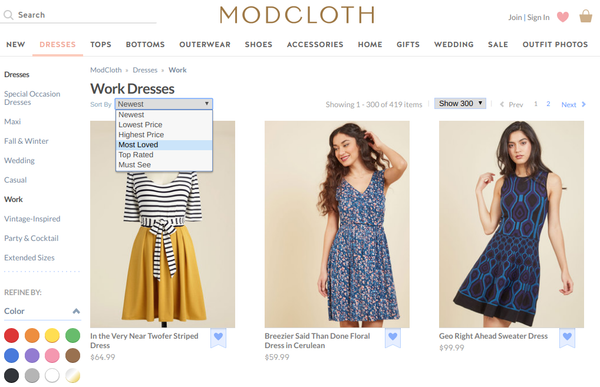
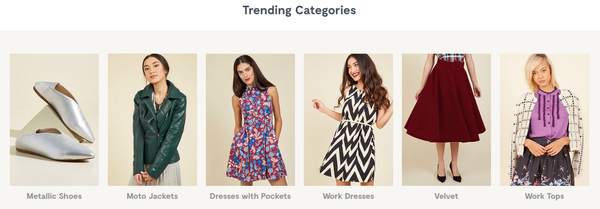 Once shoppers get to a specific category, they can sort hundreds of items by “Most Loved” or “Top Rated.” Both of these are important factors in social proof.
Shoppers can feel more confident that the items they choose line up with what others like, too. That removes some doubt or uncertainty about whether they’re making the correct choice.
Did you garner press mentions? Were you featured in a major publication? Did your business win awards?
Show them off! This is a strong display of social proof that makes customers feel more confident in your brand. Media interest can pique customer interest, and awards and accolades can reinforce their belief in your products’ quality.
You can display great ratings, titles you won, and other praise in the form of signs in store or banners on your website.
Social proof in retail is when shoppers use other people’s actions and feedback—like reviews, testimonials, “best seller” labels, or a busy store—to decide what to buy. It reduces uncertainty and helps customers feel they’re making the “right” choice.
There are a few common frameworks. One widely used approach (popularized in marketing) includes six types:
For more background, see Buffer’s guide to social proof types and examples.
Social proof works by reducing uncertainty. When someone isn’t sure what to do, they often use other people’s behavior (or feedback like ratings and reviews) as a shortcut for deciding what’s safe, popular, or “right.” In marketing, that’s why customer reviews, testimonials, and “most popular” collections can increase confidence and help shoppers decide faster.
Start by enabling product reviews and displaying star ratings on collection pages and product pages, then add customer photos where possible. Next, create “Best Sellers” or “Top Rated” collections and feature them in your navigation so shoppers see popularity signals early.
Many social proof apps offer free plans or low-cost entry tiers, with pricing increasing as you add features like photo reviews, on-site purchase notifications, or advanced moderation. If you’re budget-conscious, begin with basic reviews and testimonials first, then upgrade once you know which placements improve conversion.
Social proof builds when you make it easy for others to discover it. These triggers indicate to potential shoppers that a larger community chose shopping with you as the right action to take — which can influence people to become new customers of your store.
If you want to put social proof to work online, start by collecting reviews, adding customer photos, and highlighting bestsellers on your product and collection pages. Then test what moves the needle (for example, review placement, star-rating visibility, and “popular” badges) and keep what improves conversion.
Pick one high-traffic product and make its proof impossible to miss: add reviews, feature a short testimonial, and include a “Top Rated” or “Best Seller” cue where shoppers decide. Then extend the same approach to your most-visited collection page and your storefront signage so customers see consistent confidence signals online and in person.
Ready to turn trust into sales? Build and refine your storefront with Shopify—then start testing social proof placements that help shoppers choose faster and buy with confidence.
Grow your retail business
Get exclusive behind-the-scenes merchant stories, industry trends, and tips for creating standout brick-and-mortar experiences.
By entering your email, you agree to receive marketing emails from Shopify.
popular posts
The point of sale for every sale.
popular posts
2023-03-01
2022-03-16
2023-12-01
2023-11-28
2023-10-27
2023-07-27
2023-12-04
2023-01-10
Unsubscribe anytime. By entering your email, you agree to receive marketing emails from Shopify. By proceeding, you agree to the Terms and Conditions and Privacy Policy.
Learn on the go. Try Shopify for free, and explore all the tools you need to start, run, and grow your business.
Start free then enjoy 3 months for US$1/month