
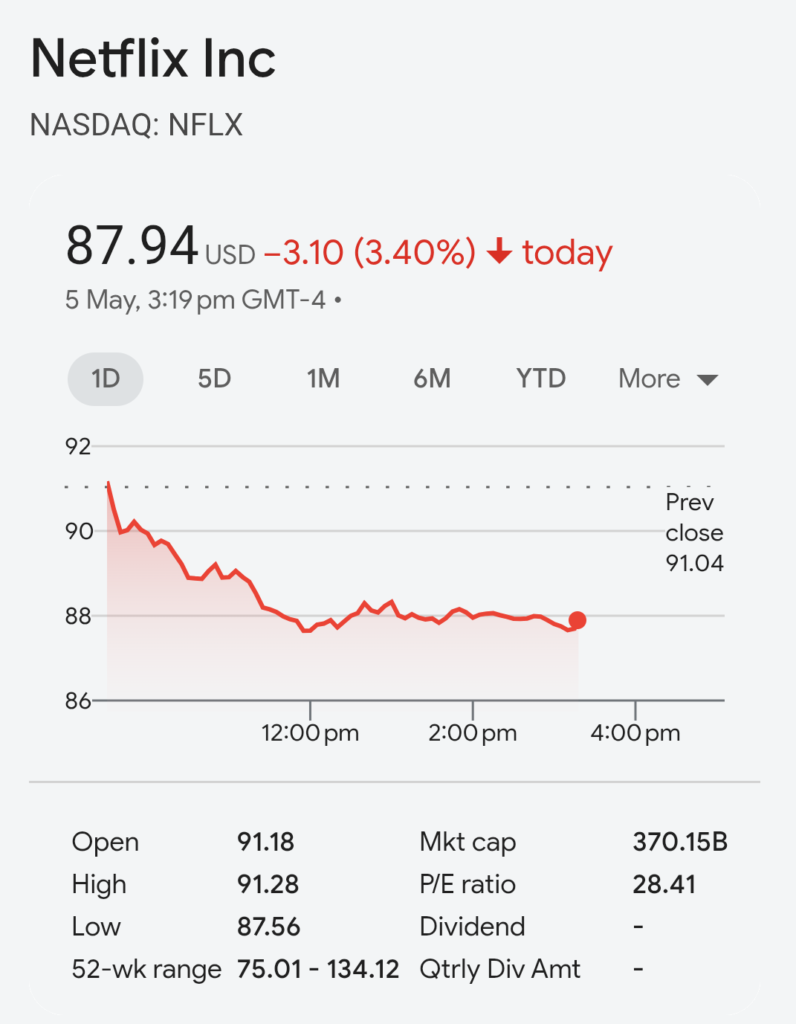
Hey, fellow managers eyeing those long-term portfolio builders—Netflix’s stock just took a 10% haircut around mid-April 2026, right after what looked like a killer Q1 earnings report. It dropped from about $107 to $97.31 in a single session on massive volume, wiping out recent gains and sparking debates on whether this is a buy-the-dip moment or a sign of maturing growth pains.
Earnings Beat, But Guidance Flopped
Netflix crushed Q1 2026 numbers: revenue hit $12.25 billion (up 16% YoY, beating $12.18B estimates), EPS came in at $1.23 (smashing $0.78-$0.79 forecasts), operating income rose 18% to around $4 billion, and free cash flow doubled to $5.1 billion. Ad-tier signups made up 60% of new subs, showing that crackdown on password sharing and cheaper plans are paying off.
Yet the stock tanked because Q2 guidance disappointed—projecting $12.57-12.6B revenue (flat to slightly below consensus) and EPS of $0.78 vs. $0.84 expected. Full-year revenue outlook stuck at $50.7-51.7B, shy of Street hopes around $51.38B. Management blamed front-loaded content spend on big 2026 launches, but investors hate when “strong now” meets “meh ahead.”
Reed Hastings’ Surprise Exit
Adding fuel, co-founder and Chairman Reed Hastings announced he’d step down from the board at the June meeting, shifting to philanthropy. No disagreements cited, but the timing—right amid the guidance miss—rattled folks. Hastings steered Netflix from DVDs to streaming dominance; his exit symbolizes a leadership handoff to co-CEOs Ted Sarandos and Greg Peters, who’ve run ops since 2023.
Markets read it as uncertainty in a saturated space, amplifying growth worries even if fundamentals scream cash machine.
Broader Market Jitters
This isn’t isolated—streaming’s a battlefield now. Netflix leads with 260M+ subs, but Disney+, Amazon Prime Video, Apple TV+, and others chip away with bundles, sports, and lower ARPU in fights for eyeballs. Price hikes helped short-term, but saturation in the US/Europe means betting on international and ads/gaming/live events (like wrestling).
Content costs balloon (tens of billions yearly), margins dipped to 31.7% (vs. 32.5% hoped), and churn risks rise as viewers rotate services. Post-drop, NFLX trades at more reasonable multiples, down from YTD highs.
Long-Term Investment Case
For us long-haul players, this dip screams opportunity if you buy Netflix’s moat: unmatched data-driven recs, global content scale, and FCF war chest for buybacks or bets like ads (60% new signups) and live sports. Analysts like Morgan Stanley kept “Overweight,” calling it timing noise, not fundamentals—ARK and hedges bought the dip.
Risks? Competition erodes pricing power; gaming/live unproven; regs abroad. But with 13-15% revenue growth guided and margins expanding via leverage, it’s maturing into a cash cow, not a hypergrowth bet. At $97, it’s closer to fair value for patient holders.
Should You Scoop Shares?
Factor ___ | __________________Bull Case_________________________ | ____________Bear Case
Growth ___ | Int’l expansion + ads/live = runway past saturation | Mature markets cap subs; ARPU lags
Financials _| FCF $5B+/- margins to expand_____________________| Content inflation squeezes profits
Leadership | Proven co-CEOs; Hastings planned exit___________ | Visionary gone amid volatility
Valuation _ | Post-dip multiples attractive; analysts buy_________ | High for media peers if growth slows
Catalysts _ | Q2 ads traction, sports deals______________________ | Churn from bundles/competitors
Bottom line: If your portfolio craves resilient tech-media hybrids with pricing power and global scale, average in now—history shows Netflix rebounds from “guidance whiffs.” Watch Q2 for guidance lifts; this could be your 2026 entry.