
The Wingman was ‘born out of design necessity.’
June 4, 2026
Replaced, a 2.5D pixel art adventure game released by Sad Cat Studios and Thunderful Publishing in April, originally had a lore problem. The narrative team wanted to feature a vast number of lore items with a graphical display, emphasizing the cyberpunk-meets-noir aesthetic. But this decision quickly bloated the scope of the project.
In order to combat this, game director Yura Zhdanovich was inspired by the GameBoy Camera and Sony's Walkman to create an in-game device that can serve as a hub for scanned items (as well as a music player for songs found during the player's travels).
The so-called Wingman can be opened at any time by protagonist Reach during exploration sequences. Rather than popping a menu up on screen, the camera shifts to a first-person perspective, showcasing the sci-fi gadget up close with a view of the protagonist's hand manually controlling it.
"The hand animation itself is a heavily stylized 3D model with [full-screen] pixel post processing—that pipeline made iteration much easier," Zhdanovich said over email. In Replaced, aside from some close-up shots during cutscenes, characters and key elements tend to be quite far away from the player's vicinity, making the Wingman stand out.
Bungie experiments by adding casual PvP-lite mode to Marathon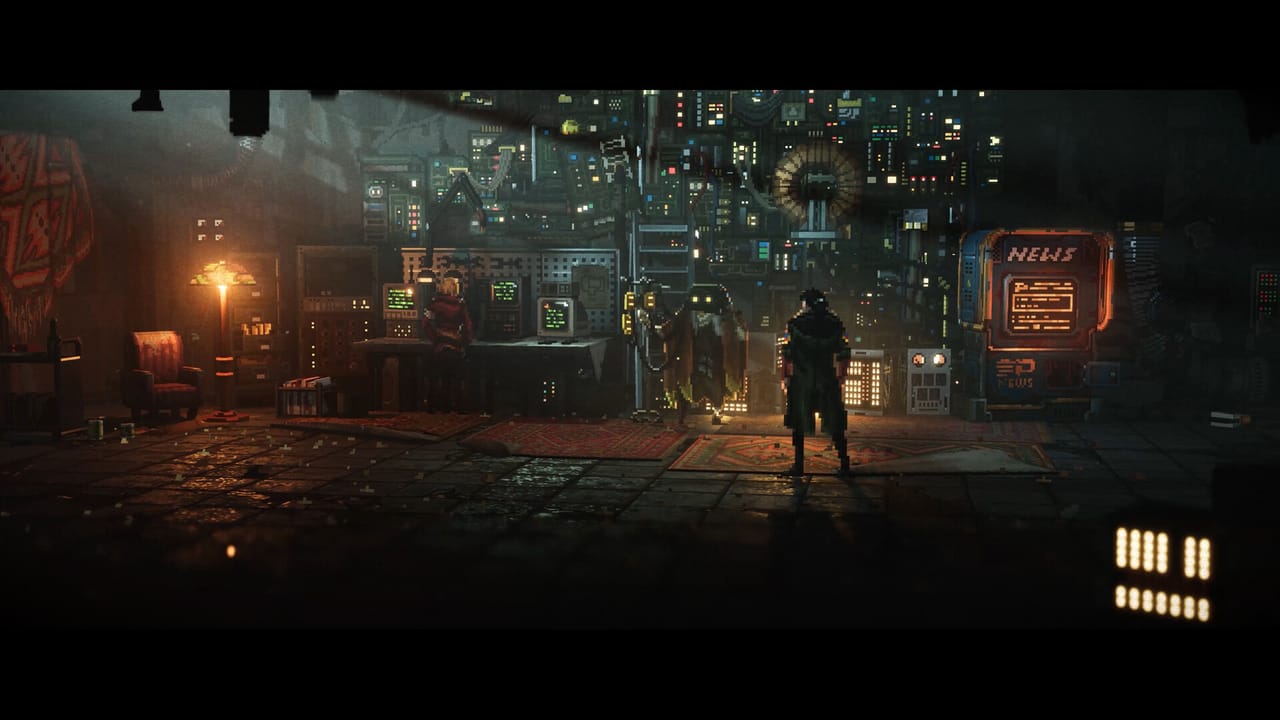
Implementing the gadget was a lifesaver. At first, the protagonist would inspect different categories of items. This, as the director explains, would have required unique sets of animations for each group. In the final iteration, once you scan an item that has a lore entry, it automatically gets added to the Wingman. Everything is centralized in it.
The Wingman has a wheel on the right side. Whenever you scroll upwards or downwards, the hand matches the action with an animation, creating the fantasy of a tactile, grounded element.
Capturing this feel was important, considering retro tech like Sony's Walkman was used as an inspiration.
"Nowadays we have lots of fidget toys that are here to compensate the lack of tactile interactions with objects/tech," Zhdanovich says. "Everything we do on our smartphones is just tapping and swiping. You don’t get this satisfying snap of closing your flip phone anymore (and I would not risk a sassy closing flip with modern flip smartphones). So animating Reach's hand and making all of the Wingman parts tactile was a part of us trying to immerse you in this world."
Because of the Wingman's change in perspective, the team had to be wary of edge cases when there are NPCs or obstacles around the character that can make transition look ugly. "It does not really pause the game, so we had to be mindful of restriction zones in the game where the player can’t actually use it," he says.
Crafting Clair Obscur: Expedition 33’s mournful tale ft. Jennifer Svedeberg-Yen
There was another big consideration in mind: text legibility. This wasn't related to the UI style—which is itself inspired by the first generation iPod. There's a fine line between having a readable and unreadable text, since the gadget's not exactly taking up all the screen real estate like a traditional overlay UI would.
Zhdanovich said the team wanted to add mini-games, more settings, and an animated cassette change process when cycling through music, which were left off the table. But hacking animations are still in process. A hacking add-on will be added in one of the post-launch updates planned for the game.
The team wanted for this hacking module to be present at launch, but as Zhdanovich explains, the idea for the in-game device came later in development. In a way, this helped to create visualization opportunities for some of the gameplay elements that the team was already working on, such as the video conference-style conversations that happen with key characters in the story.
The Wingman serves as a solution that both fits the in-game universe and saved the team time and effort with the plentiful lore entries. "The decisions have always been informed by one strong notion, which is "let's not create extra entities—better make use of what we have to the fullest extent and support the core theme,'" the director says.
Star Trek: Voyager – Across the Unknown reinvents TV storytelling for survival strategy – Narrative Notebook #3
"It was a bit of a risk, especially in the screen real estate debate, but it paid off big time."
Read more about:
Diego Argüello
Contributing Editor, News, GameDeveloper.com
Diego Nicolás Argüello is a freelance journalist and critic from Argentina. Video games helped him to learn English, so now he covers them for places like The New York Times, NPR, Rolling Stone, and more. He also runs Into the Spine, a site dedicated to fostering and supporting new writers, and co-hosted Turnabout Breakdown, a podcast about the Ace Attorney series. He’s most likely playing a rhythm game as you read this.
Crafting Clair Obscur: Expedition 33’s mournful tale ft. Jennifer Svedeberg-Yen
Stories from making Marvel Rivals
We tested the Steam Controller
Supporting juniors and sharpening your creativity
Copyright © 2026 Informa. This website is owned and operated by Informa. Informa PLC's registered office is 5 Howick Place, London SW1P 1WG.