
Charted: AI Articles Have Overtaken Human Written Ones
Mapped: The States Where Businesses Use AI Most
Ranked: The Smartest AI Models of 2026
Ranked: AI Models U.S. Businesses Pay For
Ranked: The Companies That Sell the Most AI Chips
Ranked: The World’s 50 Largest Banks by Assets
Every S&P 500 Company in One Giant Chart
SpaceX’s IPO Would Make It a Top 10 Company Globally
Charted: The Global Stock Selloff as Oil Fears Rise
Warren Buffett vs. the S&P 500: Growth of $100 (1965–2025)
Ranked: The World’s 20 Busiest Ports
Mapped: Where Young Americans Still Own Homes
Mapped: Where Housing Takes the Biggest Share of Income
Mapped: Which States Give More to Washington Than They Get Back
The $126T Global Economy in One Giant Chart
Mapped: Europe’s Social Media Gap by Country
Mapped: Social Media Use Among Europe’s Youth
Charted: AI Articles Have Overtaken Human Written Ones
Mapped: The States Where Businesses Use AI Most
Ranked: The Smartest AI Models of 2026
How Government Debt Has Diverged Across Major Economies (2005–2025)
Ranked: Where Wages Go Furthest Around the World
The $126T Global Economy in One Giant Chart
Charted: U.S. Debt Could Hit $182 Trillion by 2056
Where the World’s $13T in Sovereign Wealth Is Held
Mapped: The U.S. Is Split on Legal Marijuana—Here’s Where
Mapped: Life Expectancy by U.S. State
Mapped: U.S. States With the Highest Diabetes Rates
Mapped: Adult Obesity Rates Across All 50 U.S. States
Ranked: The World’s 10 Deadliest Viruses by Fatality Rate
Charted: The Global Fertility Divide
Ranked: Where the World’s Migrants Live Today
Mapped: Europe’s Social Media Gap by Country
Mapped: Every Country’s Fertility Rate as Births Decline Worldwide
Mapped: Europe’s Birth Rate Collapse
Ranked: The World’s Largest Oil Stockpiles
Ranked: The Fastest-Growing Battery Materials Since 2020
China Produces More Coal Than the Rest of the World Combined
Coal Still Generates More Electricity Than Any Other Source
Ranked: The World’s Biggest Coal Consumers
Mapped: Where Young Americans Still Own Homes
Mapped: Where Housing Takes the Biggest Share of Income
Mapped: Which States Give More to Washington Than They Get Back
Mapped: Most Americans Can’t Afford New Homes
Mapped: The U.S. Is Split on Legal Marijuana—Here’s Where
These Countries Hold Most of the World’s Copper
Ranked: Central Banks Buying and Selling Gold in 2026
Ranked: U.S. Import Reliance for 37 Critical Minerals
Visualizing the Critical Minerals Powering the AI Boom
Ranked: The Critical Minerals Lost to U.S. Mining Waste, by Tonnage
Ranked: Where Emissions Are Rising Fastest
How Much Clean Energy Have Countries Added Since 2015?
Mapped: Only One Country Can Feed Itself Fully
Ranked: The Countries Building the Most Nuclear Power
Ranked: CO2 Emissions Per Person by Major Economy
Published
on
By
 See this visualization first on the Voronoi app.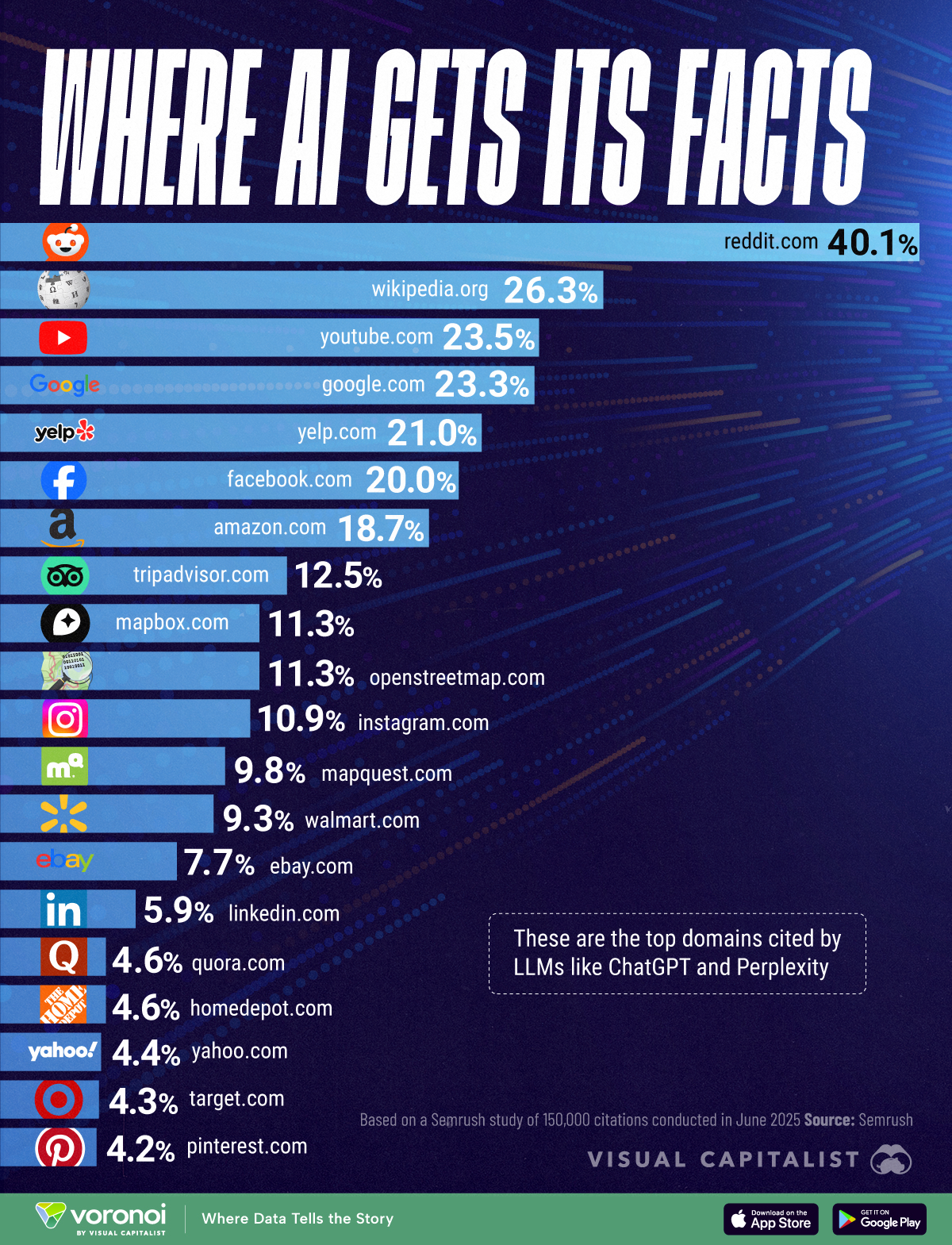
Use This Visualization
This was originally posted on our Voronoi app. Download the app for free on iOS or Android and discover incredible data‑driven charts from a variety of trusted sources.
Where do large-language models (LLMs) like ChatGPT go to source factual information?
In this infographic, we rank the most cited websites by AI, based on a June 2025 analysis of over 150,000 LLM citations. It reveals how heavily chatbots rely on user-generated content, raising questions about the blind spots of today’s top AI tools.
The data for this visualization comes from Semrush. It shows how frequently AI models cite different domains when providing information, as of June 2025.
Reddit leads the list with a citation frequency of 40.1%, followed by Wikipedia at 26.3%. This highlights how often LLMs lean on open-forum discussions and community-maintained content.
These domains offer a wealth of user-generated knowledge, but their open editing nature raises concerns about accuracy and bias. The high reliance signals that AI may amplify whatever narratives are most visible or popularly discussed—even if not always verified.
For example, users have reported that ChatGPT has suggested they purify their water with bleach, or even mix it with vinegar (this creates poisonous chlorine gas).
We summarize three major risks of relying on user-generated content below:
If you enjoyed today’s post, check out How 21 Countries View Artificial Intelligence on Voronoi, the new app from Visual Capitalist.
The World’s Most Valuable Unicorn Companies in 2025
Visualized: Desktop vs. Mobile Global Web Traffic Over Time
AI Week: 6 Insights Shaping the AI Economy
Charted: AI Articles Have Overtaken Human Written Ones
Mapped: The States Where Businesses Use AI Most
Ranked: The Smartest AI Models of 2026
Ranked: AI Models U.S. Businesses Pay For
Ranked: The Companies That Sell the Most AI Chips
An overwhelming majority of Europeans are on social media today. Germans and Italians, however, are more reluctant.
Published
on
By
See visuals like this from many other data creators on our Voronoi app. Download it for free on iOS or Android and discover incredible data-driven charts from a variety of trusted sources.
Social media use across Europe varies sharply by country, creating a clear gap between the continent’s most and least connected populations.
This map shows the share of adults active on social networking sites across Europe, based on 2025 data from Eurostat and Ofcom. Being “active” in this case involves creating a profile, posting messages, sharing, commenting, or otherwise contributing to a social networking site.
While adoption exceeds 80% in several northern countries, it drops to 56% in Italy and 59% in Germany, two of Europe’s largest economies. Overall, the European average sits at 74%, masking these wide differences in usage.
Northern Europe stands out as the region with the highest social media adoption rates.
Denmark leads the continent in social media use (90%), followed closely by Norway (89%). Sweden and the Baltic states of Estonia, Latvia, and Lithuania trail slightly behind in the 70–79% range.
This data table shows social media usage rates across European countries.
Northern Europe’s high usage reflects early and widespread adoption of digital technologies.
Estonia, for example, has earned the moniker “e-Estonia” due to its tech-savvy society and government, while companies ranging from Finland’s Nokia to Sweden’s Spotify rank among Europe’s leading digital success stories.
Even with this reputation, some Scandinavian governments are considering social media bans for children. Denmark, as the continental leader in online activity, is weighing a ban on children’s creation of social media profiles before age 15, or 13–14 with parental consent.
Western Europe has long included some of the continent’s most globalized countries. In 2005, university students in the United Kingdom were the first outside North America to join Facebook. Today, 89% of UK adults are active on social media.
However, beyond the UK, social media activity is more limited than in the Nordics. France counts 71% of its adult population on social networking sites, just ahead of Spain and Portugal (both 70%).
For their part, the Benelux countries show an interesting contrast: 81% of Dutch adults use social media, compared to 67–68% in Belgium and Luxembourg.
Italy has the lowest social media usage rate in Europe, with just 56% of adults active on social networks. This represents a gap of more than 30 percentage points compared to countries like Denmark, Norway, or the UK.
The contrast also appears generational, as over three-quarters of Italian teens self-report being addicted to their phones.
Germany (59%) is the only country near Italy’s low rate of social media usage. German society appears more divided on the benefits and drawbacks of social networking sites, with nearly half of surveyed Germans in 2025 saying they would rather live in a world without social media.
To learn more about this topic, check out the What are Gen Z’s Favorite Social Media Platforms? on Voronoi.
Social media has always depended on young adults. Today, there’s a clear gap between France and the UK versus countries like Italy.
Published
on
By
See visuals like this from many other data creators on our Voronoi app. Download it for free on iOS or Android and discover incredible data-driven charts from a variety of trusted sources.
Social media use among young adults (aged 16–29) in Europe is nearing saturation, with many countries approaching universal adoption.
But two of Europe’s largest economies stand apart.
Data from Eurostat and Ofcom shows a clear gap. While countries in Northern Europe and the Balkans lead, major economies like Germany (84.2%) and Italy (80.3%) lag behind their peers.
In countries like Denmark or Czechia, social media use is close to universal among young adults.
Germany and Italy break from this pattern, highlighting how cultural and structural factors continue to shape digital behavior.
Below is the full ranking of 34 European countries by social media use among young adults:
Cyprus and North Macedonia have the highest rates of young-adult social media use in Europe, followed closely by Czechia, Denmark, Finland, Serbia, and the United Kingdom.
In these countries, social media functions as essential infrastructure, used for everything from coordinating study groups to maintaining social circles. Being offline can make young people effectively invisible in networks that increasingly operate online.
While social media use exceeds 90% across much of Europe, Germany and Italy stand apart.
Germany, Europe’s largest economy, has 84.2% of young adults on social media, well below many of its neighbors. Italy is lower still at 80.3%, meaning one in five young adults are not on any social platform, the highest share on the continent.
In Germany, stricter privacy norms shaped by GDPR have contributed to a more cautious approach to online presence. Policymakers are even considering restrictions on youth access, with leaders citing the dangers of online socialization.
In Italy, lower usage may reflect a stronger role for offline social life. Everyday interactions, from evening strolls to time spent in cafes, continue to provide alternatives to digital connection.
High social media use in the Balkans is partly linked to emigration.
Roughly a quarter of Western Balkan citizens, for example, move abroad in search of higher wages and better job opportunities. For families split across different countries or even different continents, social media plays a key role in maintaining communication.
Diaspora has helped social media usage overcome the digital skepticism seen in countries like Germany or Italy.
To learn more about this topic, check out the We’re Spending More Time Watching Videos on Social Media on Voronoi.
Ranked: The World’s Most Powerful Passports in 2026
Mapped: The Cost of Living Across America
Mapped: What It Takes to Be Upper-Middle Class in Every State
Mapped: America’s Best States to Live In
Mapped: The Salary Needed to Live Comfortably in U.S. Cities
Ranked: The Most Productive Countries in the World
Mapped: Only One Country Can Feed Itself Fully
Ranked: Who Uses the World’s Coal?
Copyright © 2026 Visual Capitalist | Privacy Policy